





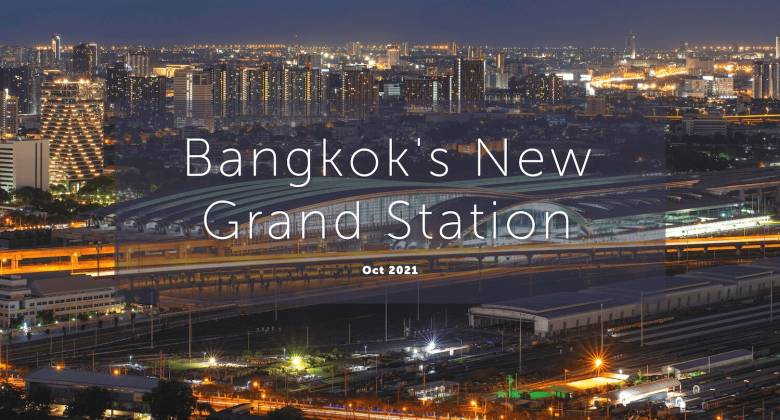
November 2021 will see the official opening of Bang Sue Grand Station, replacing the hundred plus-year-old Hua Lamphong Station as the capital’s central railway station. The station will be the terminus for all current long-distance rail services, future high-speed railways, and through-trains for the SRT commuter lines and the three-airport high-speed rail (HSR) lines.
Bang Sue Grand Station began construction in 2013 and sits beside the Sirat Expressway in the Chatuchak region. This new Central Station is positioned to become the largest transit-oriented rail hub in all of Southeast Asia. Costing 93.95 billion baht (USD 3 billion) to build, it is projected to serve up to 1.5 million passengers per day by 2037.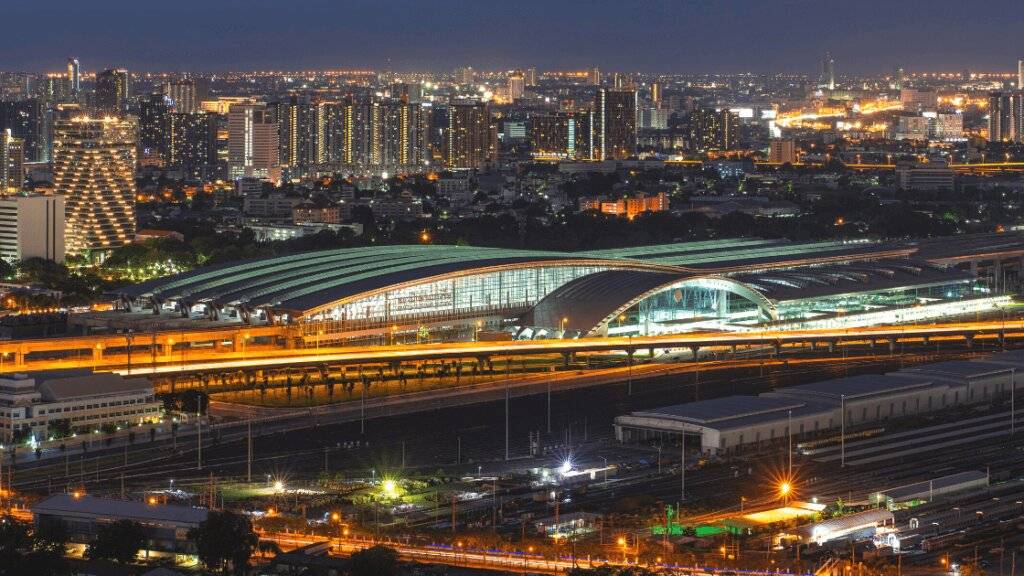 The Details
Wrapped in four storeys of reflective glass, the station complex covers 298,200 square meters – more than 40 football pitches. With 12 platforms and 24 tracks, the terminal can accommodate up to 40 trains simultaneously. Underground is home to the Bang Sue MRT Station and parking for 1,624 vehicles. The air-conditioned ground floor is the station’s concourse with ticketing and waiting areas plus expected retail and other services.
Eight tracks on the second floor will serve the country’s long-distance and inter-city diesel (soon to be electrified) trains plus the newly opened SRT Dark Red and Light Red commuter train lines. The third floor is home to the four-track high-speed Don Mueang–Suvarnabhumi–U-Tapao airports railway due to come into operation in 2023. A further six tracks await, the already under construction, high-speed rail lines to Nong Khai on the Thai-Laos border (northeastern region), plus planned but not yet approved HSR Chiang Mai line to the north and a Hua Hin southern line.
Solving Long-term Problems
The government hopes Bang Sue Grand Central Station will be more than just a transportation hub. Its commuter lines will connect more areas of Bangkok’s urban sprawl and help resolve the traffic woes of one of the world’s most congested cities. Transport Minister Saksayam Chidchob foresees the rail system becoming the primary mode of transport in Thailand and linking the country with regional neighbours. The aim is to sustainably fix the country’s overall road congestion problems by lowering logistics costs and lessening dependence on private vehicles.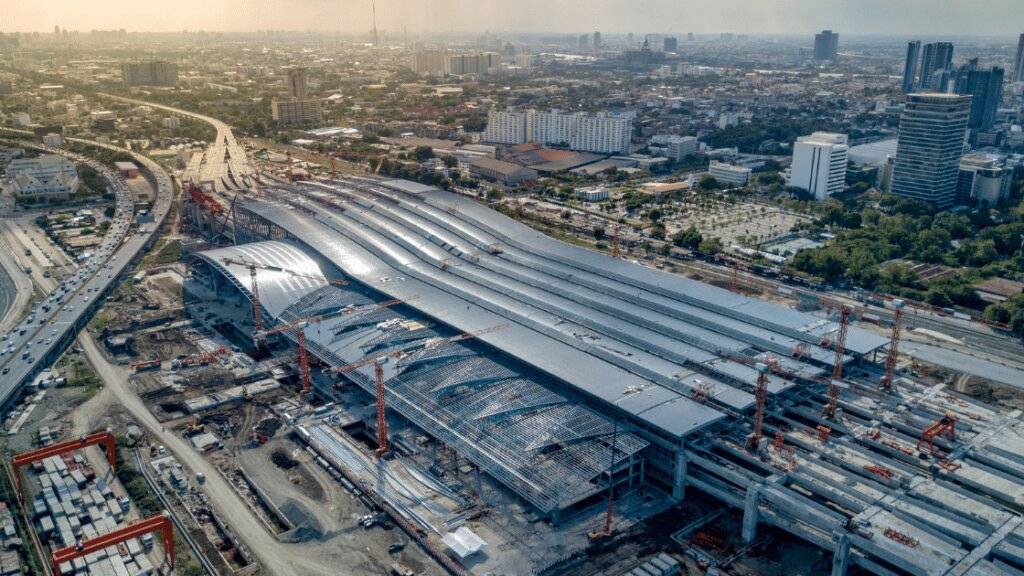 A New Smart City
The Bang Sue-Chatuchak regions already have a great selection of quality hospitals, large shopping centres, the green lungs of Queen Sirikit and Chatuchak Parks, and the famous Chatuchak – Thailand’s largest weekend market. Many government agencies and major national companies headquarters like Thai Airways International, SCG Chemical, and PTT Petrochemical are nearby. And just to the north, Bangkok’s second airport Don Mueang, used by many budget carriers, is easily accessible.
Near Bang Sue Grand Station and rail yards, some 157 hectares of State Railway of Thailand (SRT) owned land has been made available for development. In urban planning terms, new smart cities need to contain all the facilities to work, live and play efficiently. Such a plan, broken into three phases going out to 2034, has been developed. How it evolves will come down to interest and investment from developers.
Phase one (2022-2024) would see government buildings, a small business complex, a shopping complex and a commercial area. A significant meeting and convention centre, Super Arena, shopping mall and residential developments are set out for phase two (2024-2029). New hotels, further residential towers, commercial and business hubs are predicted for phase three (2029-2034).
What Do Our Lazudi Experts Say?
“It’s exciting to see Bangkok’s continued commitment to large infrastructure projects in this developing city. The completion of the largest railway station in S/E Asia is another example. Investors are always looking for the next city hotspots. Bang Sue has the potential to become a significant new hub of the city thanks to its connectivity with other future rail lines.” Alex Blencowe from Lazudi comments.
“This coincides well with the recently completed blue line MRT extension, now completing a city circle line and better connecting the west of Bangkok across the river to the rest of the city. Several developers are exploring this new area of growth, focusing on a more accessible market segment. With starting prices under 5M THB, these new developments could entice investment buyers away from more pricey locations such as Sathorn & Sukhumvit. For example, Supalai, Ananda & Pruksa have all launched projects in 2021.” Alex adds.
In Summary
Those looking for an inner-city environment with convenience, lifestyle and the most outstanding transport connectivity may find locations neighbouring Bang Sue Grand Station worth considering. The next 10-20 years will see this region become a fantastic ‘city within a city’ plus the most modern hub for regional rail travel within Thailand and beyond.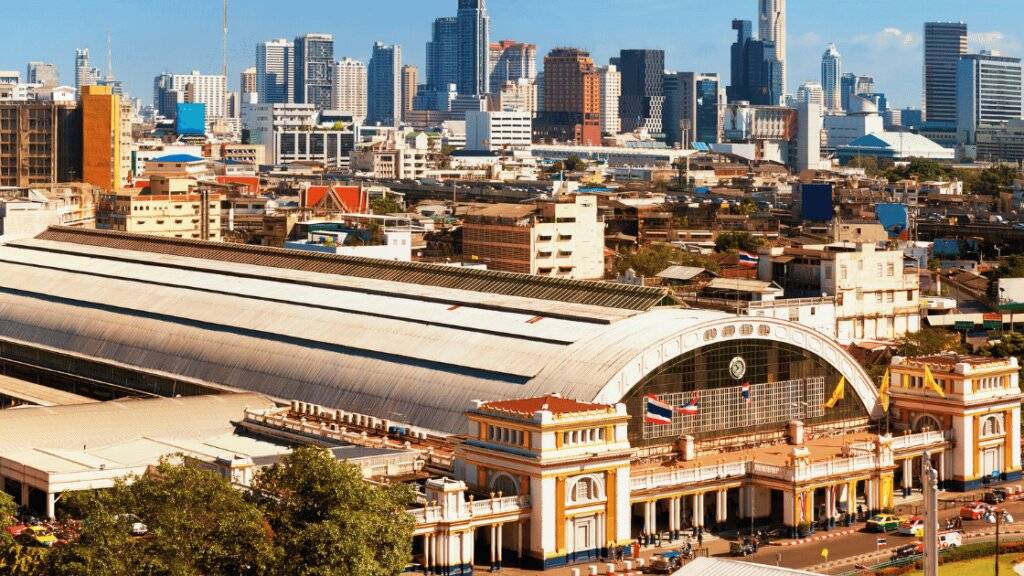 Hua Lamphong station, Bangkok’s existing central station since 1916
Read more articles about Bangkok’s gateway series:
1.Living in Phuket – What is Not to Love
2.Hua Hin – A Great Bangkok Gateway
3.Bangkok Gateway – A Great Escape to Kanchanaburi