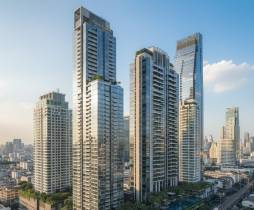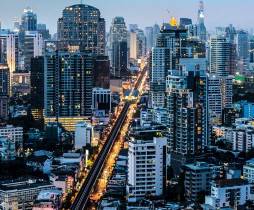







Recently, the Ministry of Energy by the Department of Energy Development and Efficiency (DEDE) has determined that condos in Bangkok-perimeter around must be designed according to the Building Energy Code (BEC), which will be effective from March 13, 2023. Currently, Thailand uses more electricity than ever before in various sectors including the government, business, industry and housing, which affects the environment from the electricity generation process.
The aforementioned ministerial regulations were announced in the Royal Gazette on November 12, 2020, including the issuance of ministry announcements and department announcements in 2021, effective for new buildings or modifying the building to be designed in accordance with legal requirements. It has been piloted on government buildings since 2011 and will come into force on the construction of private buildings on March 13, 2023. The new ministerial regulations are called the “Building Energy Code (BEC)”.
And it will apply to 9 types of buildings with a total area of every floor in one building from 2,000 square metres or more. There are minimum standards in the design of 6 systems consisting of Overall thermal transfer value/Roof thermal transfer value (OTTV, RTTV), Lighting Power Density (LPD), air conditioning system, hot water production equipment, and total energy consumption of the building and the use of renewable energy.
The building will be divided into 3 groups according to the duration of use of the building each day, in which the 3 groups are subdivided into 9 types of sub-combined buildings as follows:
Group 1 - electricity usage for no more than 8 hours per day, including educational institutions or offices.
Group 2 - electricity usage for no more than 12 hours per day, including department stores or shopping centres, service places, a convention hall, and a theatre.
Group 3 - electricity usage for no more than 24 hours a day, including hospitals, condominiums, or hotels.
The criteria for consideration will use the Building Energy Code (BEC) program, which is a program developed as a tool for calculating energy conservation values that must pass two types of standard criteria: 1. Assessment through all 6 systems or 2. Assessment of the overall energy use of the building. This can be downloaded to view the criteria for evaluating energy conservation values, more detailed documents and important news via: https://2e-building.dede.go.th/
According to DEDE's report, buildings constructed under BEC standards will increase construction costs by 5% compared to typical buildings, but it will be more energy efficient compared to the typical building, not less than 10%.
From the results of the study, it was found that there are an average of 3,300 new buildings per year, 3,000 buildings per year for the private sector and 300 buildings per year for the public sector. Under BEC standards, electricity consumption can be reduced by 1,400 million units per year. The value of money saved is approximately 5,000 million baht per year. When calculating the increase in construction costs from construction under BEC standards, it will take time to pay back the increased costs within 42 months or 3 years and 6 months.
Additionally, BEC standards, other than being effective for new buildings that apply for permission after March 13, 2023, also affect buildings under construction that will be completed after March 13, 2023.
According to the above criteria, to open the building, it is necessary to be inspected. If it does not meet the criteria of BEC within 15 working days, the local office has the power to order the building to be corrected according to the standards set before being able to open the building.
Final thought…
Even if it hasn’t been officially confirmed, it shows a positive sign for those looking to invest in a commercial property, especially in a major area in Bangkok. This will also be in line with COP26 which Thailand has pledged which the country aims to reach carbon neutrality by 2050. They also have expressed a desire to reach net-zero greenhouse gas emissions by 2065.