





How to Select the Right Retail Space for a Restaurant in Bangkok (Without Paying for the Wrong “Foot Traffic”)
Bangkok is a city where restaurants can look busy and still lose money. The usual culprit isn’t the menu—it’s the real estate decision: the wrong street, the wrong unit, the wrong lease, or the wrong building constraints that quietly cap your revenue while costs keep running. If you’re choosing a space because you “love the vibe,” you’re already negotiating from a weak position.
A good restaurant site in Bangkok is one where demand drivers, unit economics, and building realities line up. The only way to get there is to treat site selection like an investment underwriting exercise—not a design project.
Start with the model, not the map
Before you tour locations, define what the space must do for your concept. Bangkok punishes vague concepts because rents, fit-out costs, and competition are all high.
Lock these down first:
-
Your average ticket size and expected table turns (or delivery order volume).
-
Your required front-of-house vs kitchen ratio (a café and a Thai BBQ unit are not the same animal).
-
Your target occupancy cost (rent + common area charges + fixed building costs) as a percentage of sales—set a hard ceiling.
-
Your “non-negotiables”: ventilation, grease management, electrical load, gas, waste handling, staff access, and parking/rider access.
If your model only works when everything goes perfectly, the space will kill you. Bangkok has too many variables—traffic patterns, seasonality, rain, building rules, and landlord behavior—to rely on best-case scenarios.
Bangkok demand drivers are hyper-local
“Good area” is meaningless here. Bangkok is a city of micro-markets—one side of the road can win while the other side bleeds.
Pressure-test demand by daypart:
-
Weekday lunch: office density, walkability, queue tolerance, speed of service.
-
Weeknight dinner: residential catchment, discretionary spend, parking.
-
Weekend: tourism, destination pull, mall traffic patterns, events.
Then match concept to the right demand engine:
-
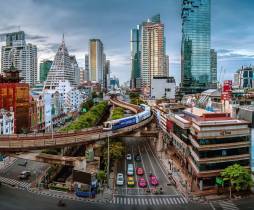
Transit-led (BTS/MRT nodes): high volume, high competition, fast decision-making by customers.
-
Destination-led (Thonglor/Ekkamai-style clusters): customers will travel, but expectations and fit-out spend rise.
-
Community-led (dense residential pockets): repeat business is possible, but only if convenience is frictionless.
-
Mall-led: predictable footfall, strict rules, sometimes revenue share—good for brands that can execute consistently.
Don’t fall for raw “foot traffic.” Ask the harder question: is it the right traffic for your price point, your service style, and your operating hours?
Visibility and access: the “3-second rule”
Most restaurant decisions are made in seconds. In Bangkok, street clutter, trees, parked vehicles, and signage restrictions can erase you.
Look for:
-
Clean sightlines from the natural walking/drive direction.
-
Frontage width that fits your concept (narrow units limit signage and perceived capacity).
-
Entry friction: stairs, hidden doors, awkward turn-ins, security desks.
-
Pick-up flow for delivery: rider parking, handoff point, and whether your lobby becomes chaos during peak.
One common mistake: choosing a unit on a busy road without a safe or convenient way to stop. High traffic speed can be worse than medium footfall with easy access.
Building constraints that quietly decide your menu
Bangkok buildings vary wildly: older shophouses, mixed-use condos, office podiums, and malls all come with different limitations. These limitations often dictate what you can sell, how fast you can serve, and whether your neighbors complain you out of existence.
Inspect and confirm early:
-
Exhaust and ventilation route (and whether you’re allowed to penetrate the façade/roof).
-
Grease trap availability and drainage slope—retrofits can be expensive and disruptive.
-
Power capacity (especially if you’re running heavy equipment, AC, or electric cooking).
-
Gas permission (some buildings restrict it).
-
Fire safety requirements: hoods, suppression, exits, alarm tie-ins.
-
Noise and odor controls—condo juristic offices can become your de facto regulator.
If the space can’t support your kitchen properly, you’ll end up redesigning the concept to fit the building—which is the reverse of how this should work.
Lease structure: where restaurants get trapped
A restaurant lease should be built for operational reality: fit-out time, ramp-up time, seasonality, and the possibility you need to exit or expand.
Key clauses to negotiate (or walk away):
-
Fit-out period: rent-free or reduced rent while you build (and clear start/end dates).
-
Handover condition: what you receive—bare shell, with MEP, with flooring, with grease trap—everything should be written.
-
Permitted use and exclusivity: prevent the landlord from leasing next door to your direct competitor.
-
Escalations: predictable increases beat “market review” surprises.
-
Renewal options: if you build a brand there, you need a path to stay.
-
Assignment/sublease rights: restaurants need an exit strategy; landlords often try to block it.
-
CAPEX ownership at end of term: clarify what must be removed and what can stay.
If a landlord is inflexible on fundamentals, assume future negotiations will be worse—because they will.
Total cost beats headline rent
Bangkok tenants get distracted by base rent and ignore the real number: total occupancy cost.
Model the full monthly load:
-
Base rent
-
Common area / building fees (where applicable)
-
Utilities and AC arrangements
-
Waste collection fees
-
Required maintenance contracts (hood cleaning, grease, pest control)
-
Insurance requirements
-
One-time costs: deposits, legal, approvals, fit-out
A “cheap” unit with expensive compliance retrofits is not cheap. Conversely, a higher rent unit with the right infrastructure can be financially safer because it reduces capex and accelerates opening.
Don’t skip regulatory and neighbor reality
Rules vary by district and by building governance. Even when something is technically possible, it may be practically blocked by a juristic office, neighbors, or the landlord’s internal policies.
Before signing, confirm:
-
Basic restaurant licensing pathway for that location and building type.
-
Whether alcohol sales are feasible for your concept (if relevant).
-
Signage rules and approval process.
-
Operating hour constraints and complaint risk.
If you can’t operate the hours your model requires, the space is a non-starter no matter how attractive it looks.
A practical site-selection approach that works
Treat the process like a funnel:
-
Start with 20–30 candidate units in your target trade areas.
-
Shortlist 5–8 after a first-pass check on visibility, access, and basic infrastructure.
-
Do deep due diligence on the top 2–3: lease terms, building constraints, and a realistic cost-to-open.
-
Only then commit.
At Lazudi Commercial, we push for this discipline because it protects you from the two most expensive restaurant mistakes in Bangkok: overpaying for “potential” and signing a lease you can’t operationalize.
Spark idea: If you’re looking east, the Bang Na–Udom Suk corridor can outperform expectations for concepts that win on repeat community traffic plus delivery radius—especially near transit and dense residential clusters where rider access is clean.
Bart Roger G. Claeys